
Module One
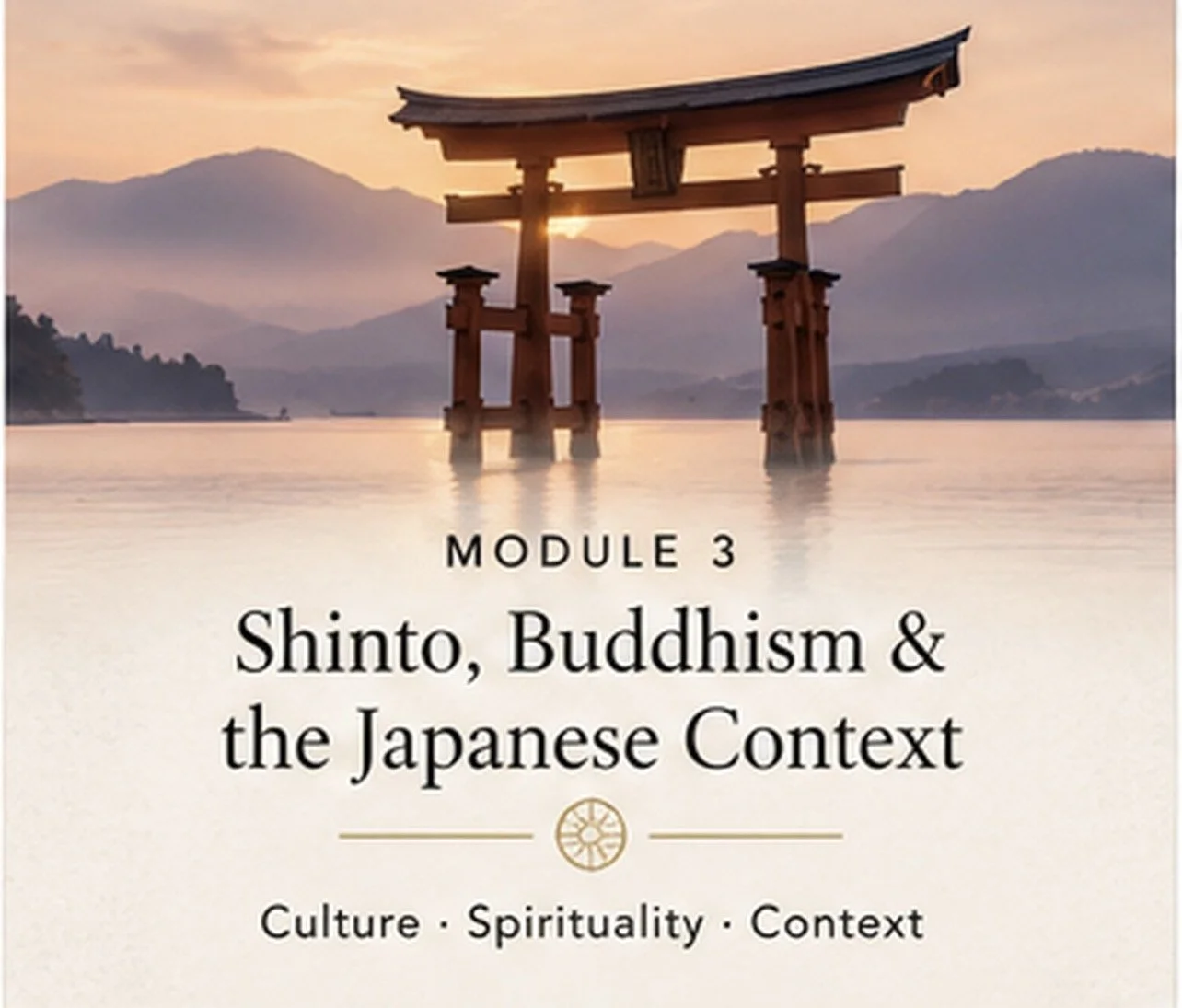
Deepening Reiki • Module 3
Shinto, Buddhism & The Japanese Context
Exploring the spiritual, cultural and philosophical environment surrounding the development of Reiki in Japan.
Understanding the Spiritual Landscape
To understand Reiki more deeply, it is helpful to explore some of the Japanese spiritual traditions that formed part of the wider cultural environment in which Mikao Usui lived and taught.
Two traditions are particularly important when considering this context: Shinto and Buddhism.
Japan's spiritual landscape was not always divided into neat, separate categories. Shinto practices and Buddhist traditions interacted and developed alongside one another for many centuries.
Important distinction:
Exploring Shinto and Buddhism provides cultural and historical context for understanding Reiki. It does not mean that every Shinto or Buddhist practice is automatically a Reiki practice.
Exploring Shinto and Buddhism provides cultural and historical context for understanding Reiki. It does not mean that every Shinto or Buddhist practice is automatically a Reiki practice.
Shinto — Connection With Nature, Place & Purification
Shinto is a Japanese spiritual tradition with deep connections to nature, place, ritual and the sacred.
The concept of kami is important within Shinto. Kami can refer to sacred or divine presences and is associated with aspects of nature, places, ancestors and phenomena.
Mountains, forests, rivers, waterfalls and other natural places can carry a strong sense of sacredness.
Nature as Teacher
This relationship with nature provides an interesting perspective for Reiki practitioners.
Rather than viewing nature simply as something outside ourselves, Japanese spiritual traditions can encourage a more intimate relationship with the natural world.
“What happens when we stop seeing nature as scenery
and begin experiencing it as relationship?”
Purification
Purification practices are also significant within Shinto. Water, ritual and conscious preparation can be used to symbolically cleanse or prepare oneself before entering a sacred space.
Buddhism in Japan
Buddhism arrived in Japan centuries before Mikao Usui and became deeply integrated into Japanese culture.
Over time, different schools and traditions developed within Japanese Buddhism.
One tradition particularly relevant to the wider cultural context is Tendai Buddhism.
Tendai Buddhism
Tendai Buddhism in Japan was associated with the monk Saichō, who established the tradition around Mount Hiei.
Mount Hiei became an important centre of Buddhist learning, meditation, ritual and spiritual practice.
Context rather than direct lineage:
The purpose of exploring Tendai Buddhism here is to understand part of the spiritual environment of Japan. It should not be interpreted as proof that Reiki itself is a direct continuation of Tendai Buddhist practice.
The purpose of exploring Tendai Buddhism here is to understand part of the spiritual environment of Japan. It should not be interpreted as proof that Reiki itself is a direct continuation of Tendai Buddhist practice.
Shinto & Buddhism Together
For many centuries in Japan, Shinto and Buddhism existed alongside each other and influenced one another.
This interaction is sometimes discussed through the concept of shinbutsu-shūgō, referring broadly to the historical combination or interaction of Buddhist and kami traditions.
People could participate in practices associated with both traditions without necessarily experiencing them as contradictory.
The Japanese spiritual environment was therefore complex,
layered and interconnected.
This is important because it helps us avoid assuming that Japanese spirituality fits neatly into the categories we may be familiar with from modern Western religious culture.
The Meiji Period & Religious Change
During the Meiji period, significant changes took place in the relationship between Shinto and Buddhism.
Government policies encouraged a separation between Buddhist institutions and Shinto practices.
These changes form part of the historical background surrounding the period in which Mikao Usui lived.
This historical context is useful because it reminds us that
spiritual traditions are influenced by the social and political
environments in which people live.
Purification as a Spiritual Principle
The idea of purification appears in different forms within Japanese spiritual traditions.
For our purposes, it is useful to think of purification not only as a physical action but also as a conscious process of preparing ourselves.
Before meditation or Reiki practice, we can create a transition between ordinary activity and intentional practice.
A Simple Preparation
- Pause before beginning your Reiki practice.
- Take a few natural breaths.
- Become aware of your body and surroundings.
- Allow the activity of the day to settle.
- Bring your hands together in Gasshō.
- Set a simple intention for your practice.
Mount Kurama
Mount Kurama is often discussed in Reiki teachings because of its connection with traditional accounts of Mikao Usui's spiritual journey.
Reiki traditions commonly associate Usui's period of spiritual practice with Mount Kurama.
Tradition and history:
When discussing Mount Kurama, it is important to distinguish the traditional Reiki account from claims that can be established through historical evidence.
In this course, we honour Mount Kurama as an important part of the Reiki tradition while avoiding presenting every traditional account as independently verified history.
Regardless of how we interpret the historical details, the image of the mountain can provide a useful opportunity for reflection on solitude, nature, discipline and spiritual practice.
Nature & Sacred Space
Many people experience a change in awareness when they spend intentional time in nature.
A forest, mountain, shoreline or quiet garden can create a sense of space away from the noise of everyday life.
For Reiki practice, this can become an opportunity to develop greater awareness rather than simply seeking a particular energetic experience.
“Be present enough to notice what is already here.”
Practice: Gasshō & Environmental Awareness
If possible, take your practice outside. A garden, park, woodland or other quiet natural space is ideal.
- Find a comfortable place to sit or stand.
- Notice the temperature of the air against your skin.
- Listen to the sounds around you without trying to label them.
- Notice the movement of trees, clouds, grass or water.
- Bring your hands together in Gasshō.
- Allow your breathing to remain natural.
- Spend several minutes simply being present.
- Finish with gratitude for the opportunity to practise.
You are not trying to make anything happen. Simply notice.
Reflection
Consider the following questions:
- What does nature mean to me?
- Do I experience a difference in my awareness when I am outdoors?
- What does purification mean to me personally?
- How do I prepare myself before Reiki practice?
- What does sacred space mean to me?
Module 3 Knowledge Check
Answer each question before moving forward. There is one best answer for each question.
Question 1 of 6
0%
Key Takeaways
- Shinto provides an important context for understanding Japanese relationships with nature, sacred places, ritual and purification.
- Buddhism became deeply integrated into Japanese culture and developed into several traditions.
- Tendai Buddhism and Mount Hiei are useful parts of the wider spiritual context of Japan.
- Shinto and Buddhism historically interacted in complex ways.
- Meiji-period changes affected the relationship between Shinto and Buddhism.
- Mount Kurama is important within traditional Reiki accounts, while historical claims should be approached with discernment.
- Purification can provide a useful principle for consciously preparing for Reiki practice.
- Nature can become an opportunity to practise presence, awareness and gratitude.